TL;DR
- Grasping player motivations is key to understanding players, building your game, and boosting retention.
- Popular player motivations include competition, socializing, creativity, and completion.
- Certain genres tend to appeal to specific motivations.
- Focus your core loop on one primary motivation.
- Use meta layers to introduce new motivations or enhance the dominant one.
Imagine you finally launch a new hybrid game. Initially, you see strong early potential and great D1 retention, but then you get to D7 and see a steep drop. What happened? Many hybrid games struggle–not because the core isn’t fun– but because the core and the meta are built on the wrong player motivation. Understanding your players' motivations plays a huge role in creating a strong connection between players and your game. And that connection can be the difference between short-term engagement and long-term loyalty.
Here’s a step-by-step guide to help you understand what motivates your players and how to use these motivations to build a hybrid game that players love.
What are player motivations?
Player motivations are the specific needs or desires that your game fulfills for the player. More often than not, they can be categorized according to genre. The most popular motivations include:
Competition
A common motivation for action and strategy players, competitive players are motivated by the thrill of winning, whether against others or themselves. Features like races, with obstacle-filled tracks and intuitive controls, tap into this motivation. Players use power-ups to reach the finish line first, unlock new content, enjoy multiplayer races, and climb leaderboards.
Socializing
This motivation is popular for simulation and strategy players who love connecting with others, making team-based activities particularly appealing. These features encourage collaboration, allowing players to build relationships and enjoy shared experiences within the game.
Creativity
For players of simulation games, creativity is a key motivation. They are driven by the desire to design their own homes, clothes, or shops, allowing them to creatively express themselves and personalize their gaming experience.
Completion/Achievement
Completion is a major motivation for puzzle players who are set on achieving goals, collecting an entire set, winning three stars, completing a check list of tasks, finishing side quests, or earning unique trophies. These players will endure grind and tedious tasks to make sure no stone is left unturned. Chase features work really well here since they introduce urgency, speed, and active movement to traditionally static or logic-heavy gameplay. These elements challenge players to solve problems under pressure and track moving targets to achieve their objectives.
So how can you leverage motivations for your game? Here’s our go-to checklist:
Step 1: Identify your primary motivation
The first step is a bit more freestyle and instinct-based. In order to nail down your primary motivation, you first need to have a deep understanding of your target audience. Since motivations can be attributed to specific genres, you can assume that if you have a puzzle game, your motivation might be completion. The rest flows from the gameplay. For example, if your game is slow paced with ASMR features, you know your target audience is likely looking for a relaxing experience, and are therefore less interested in high-pressure, competitive gameplay. In order for your game to be successful, you’ll need to set your fail conditions and economy around this understanding of your market.
Then, as you tweak and iterate gameplay, you’ll focus on your D1, D7, and D30 retention as well as conduct internal testing to see how players interact with your game, what’s making them churn, and what’s interesting to them over time. For example at Supersonic, we worked on a game that attracted less-skilled players despite the fact that the UX of the game required a very high skill level. Once we understood that there was a mismatch between the player’s motivation and the gameplay (they were not looking for a competitive game), we tweaked the gameplay to more accurately reflect the players’ motivations.
Step 2: Perfect your core using your primary motivation
Your core is the most crucial part of your game. So once you’ve pinpointed your primary motivation, make sure you apply it to your core in a way that satisfies your audience. Paying attention to retention rates is the way to go at this stage. High retention rates like 40% D1 and 15-20% D7 are key since they indicate stickiness and can confirm you’ve chosen the right motivation. This enables you to refine your core with this motivation in mind.
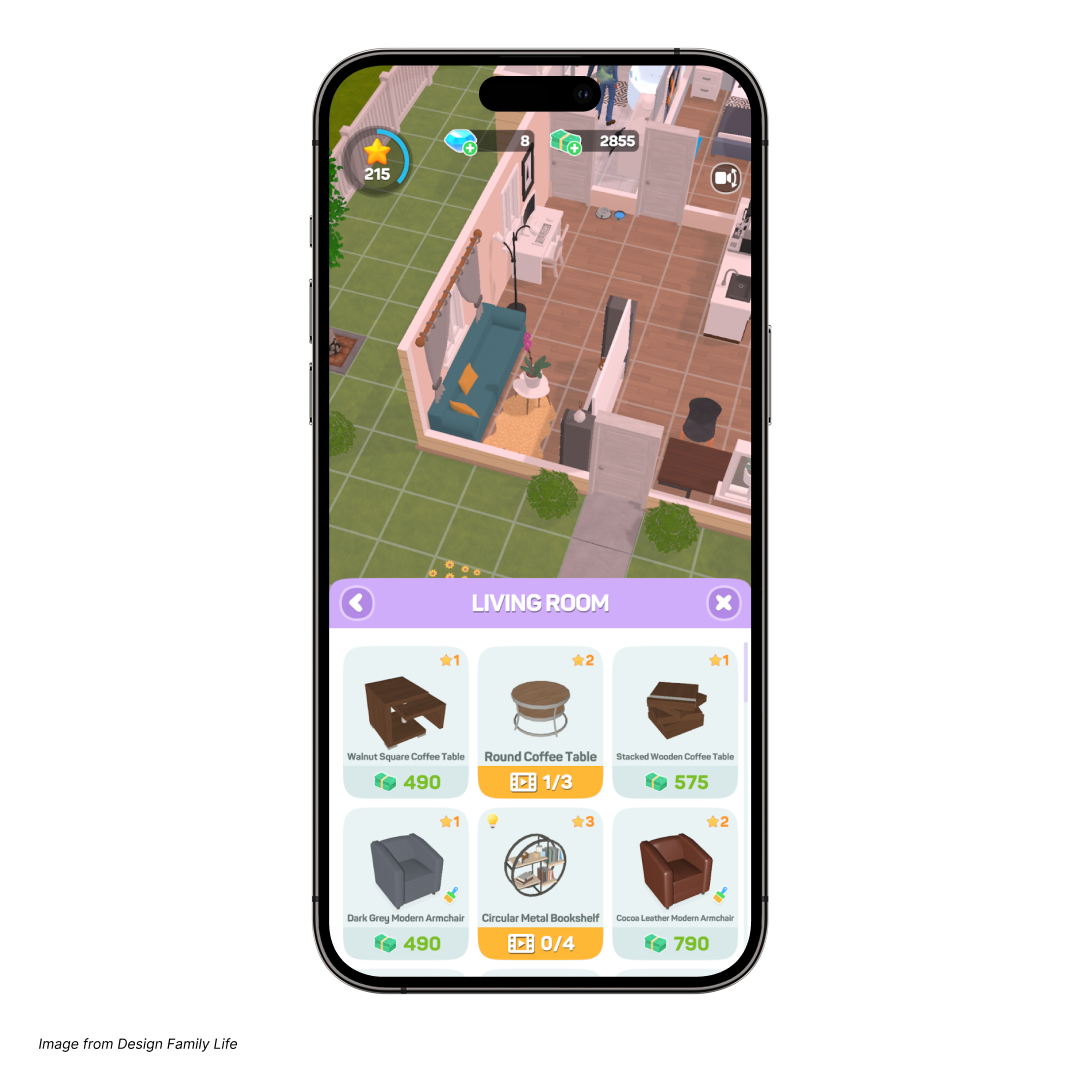
For example, when our Supersonic team started working on Design Family Life, we noticed the core loop was not as sticky as we had hoped. We played the game and compared it to similar games in the genre to understand what needed fixing. Since our players' primary motivation was creativity, we redesigned the core loop to be about designing their own homes and choosing their own furniture. To reinforce this creative motivation even more, we added a star system where certain furniture pieces earn stars. Players need these stars to unlock new stories, which encourages them to engage more deeply with the creative design process in order to progress.
Step 3a: Expand with complementary motivations
If you focus on 1 motivation throughout the entire game, your game can become repetitive and boring – causing players to drop. If this happens, you need to add depth, and that means using a different motivation in your meta. For example in a puzzle game that appeals to completionists, you can create a race meta that appeals to competitive players or features for socializers like clans or teams.
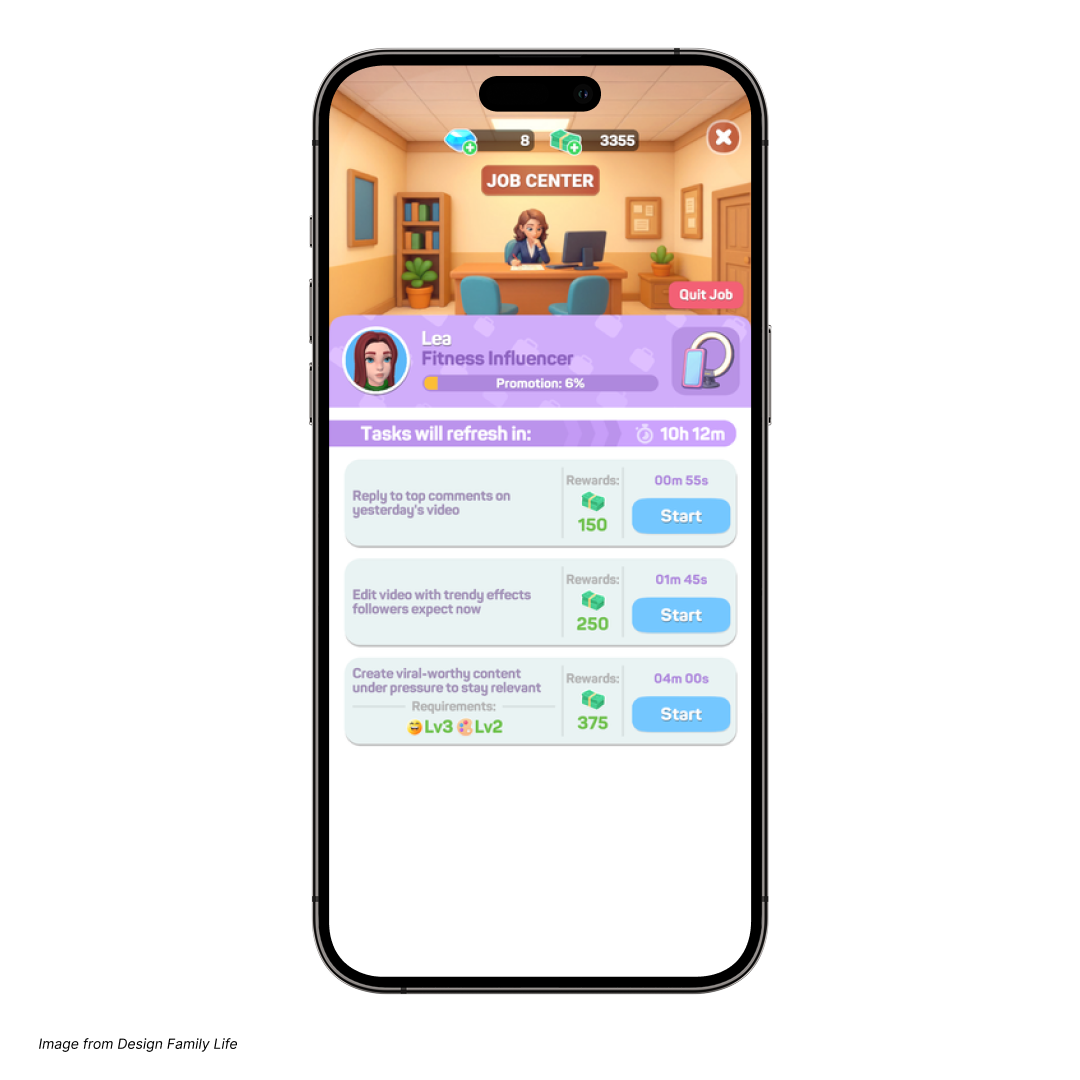
Here’s how this concept can work in practice. In Design Family Life, we noticed that in addition to the core mechanic of home design which appeals to the creative motivation, our players also cared about their character’s progression (achievement motivation). To connect with this secondary motivation, we created a job system where the player can choose what their character specializes in professionally. In order to make this work, we conducted surveys to understand which professions are most coveted by our players, giving them the opportunity to work in a ‘dream job’ that they can’t experience in real life. This appealed to them because as simulation players, they have a tendency to project themselves onto the character. So by adding this meta, we made sure that their character’s achievements turn into rewarding and fun experiences the players love.
Step 3b: Double down on the original motivation if you know it’s strong
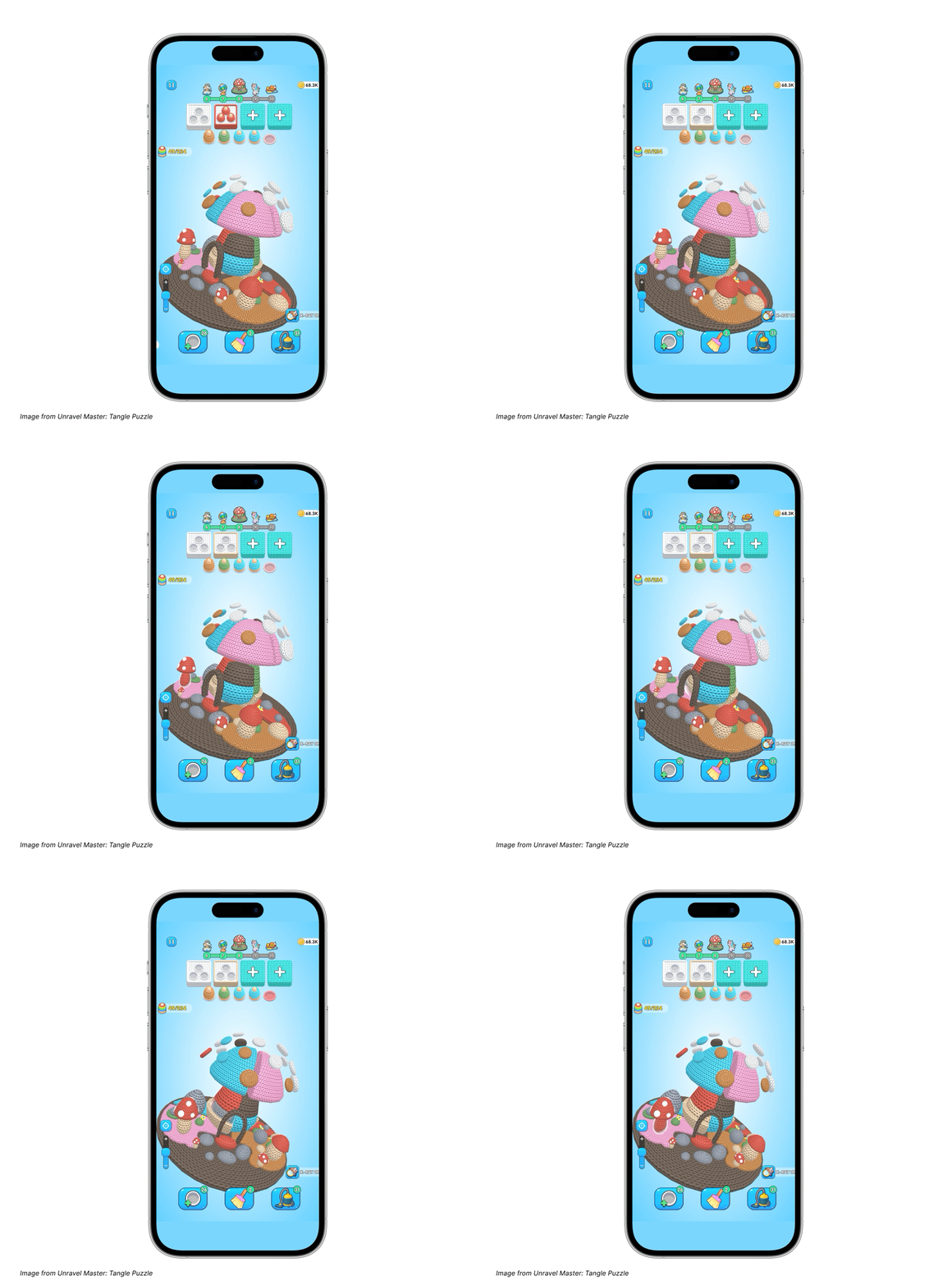
There is an exception to the above rule. If your game is super strong for a specific motivation, it’s often better to stick with that motivation in the meta as well. But that doesn’t mean you shouldn’t add new features. For example, Unravel Master saw that the game appealed to achievers who wanted to pass as many levels as possible. To leverage this motivation without making the game feel too repetitive, the team offered a free X-ray that enabled players to see which yarn colors were underneath so they could strategize how to beat each level.
Step 4: Continuously iterate and grow
Player motivations can change as they spend more time in your game. Keeping an eye on metrics like retention rates and churn rates helps you understand what's keeping them engaged, why they might drop off, and what encourages them to keep playing. Regularly tweak your game to match these changing motivations so it stays fun and engaging for everyone.
Make your game impossible to put down
Understanding player motivations doesn't have to be perfect from the get-go. You can start with your target audience's likely motivations and then iterate as you learn more. By mixing core and meta elements and tweaking them based on what you discover about player behavior, you create an engaging experience that keeps players coming back.
Want to learn how to use your players’ motivations to make your game irresistible? Supersonic helps game devs identify their players’ motivations so you can optimize retention in the core, meta, and beyond. Submit your game to see how we can make your game impossible to put down.
Let's put these tips to good use
Publish your game with Supersonic